
A ready-made online store on OpenCart 3 or development from scratch: which to choose in 2026
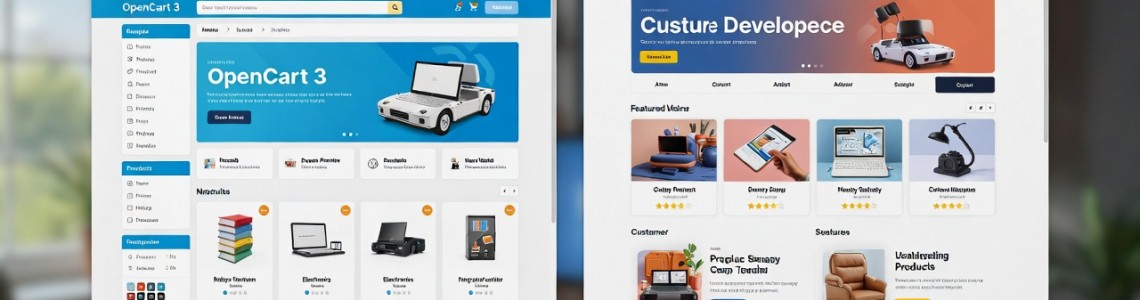
Comparing approaches to online store creation: ready-made stores, development from scratch, and builders
In the era of digital commerce, launching your own online store has become accessible to many entrepreneurs. However, choosing the right approach can significantly impact costs, time, and business efficiency. In this article, we'll compare three main options: purchasing a ready-made online store, developing a website from scratch, and using online builders. We'll explore the advantages and disadvantages of each method and provide an example of a ready-made solution based on OpenCart 3, which includes all the necessary modules, integrations with marketplaces (e.g., Wildberries, Ozon), product import/export, and SEO optimization. A table for a visual comparison is provided at the end of the article.
Buying a ready-made online store
A ready-made online store is a pre-configured platform that can be purchased and launched with minimal customization. These solutions are often based on popular CMSs such as OpenCart, WooCommerce, or Bitrix and include basic functionality such as a product catalog, shopping cart, payment, and shipping.
Advantages:
- Quick Launch: You can deploy your store in a few days, without waiting for development.
- Cost savings: The cost of a ready-made solution is usually lower than custom development—from 50,000 to 300,000 rubles, depending on the functionality.
- Ready-made integrations: Many ready-made stores already have built-in modules for payment systems (Yandex.Checkout, SberPay), delivery (CDEK, Boxberry) and analytics (Google Analytics).
- Scalability: Easily add modules for expansion without rebuilding the entire site.
- SEO Optimization: Built-in search engine optimization tools such as meta tags, sitemap and human-readable URLs.
Flaws:
- Limited customization: It is not always possible to implement a unique design or complex functionality without additional investment.
- Platform Dependency: CMS updates may require technical support.
Example: Our ready-made store on OpenCart 3 is a complete solution with all modules (order management, reviews, filters), integrations with marketplaces for synchronizing products and orders, import/export tools (CSV, XML, API), and a built-in SEO module (automatic meta tag generation, speed optimization). This allows you to quickly integrate your store with external services and start selling without unnecessary expenses.
Developing an online store from scratch
Development from scratch involves creating a website based on custom technical specifications with the help of programmers and designers. This can be done using frameworks like Laravel, Django, or even pure code.
Advantages:
- Full customization: You can implement any design, functionality, and integrations to meet specific business needs (for example, a unique loyalty system or AR product viewing).
- High performance: Optimized code ensures fast loading and load stability.
- Security: Individual measures to protect against hacks and data leaks.
- Future-proof scalability: Easy to expand for larger businesses.
Flaws:
- High cost: From 500,000 rubles and up, depending on complexity.
- Long lead time: Development can take from 3 months to a year.
- Risks: Dependence on the contractor; possible coding errors or delays.
- Additional costs: SEO, integrations, and modules will require separate expenses.
This approach is ideal for large companies with unique requirements, but for small businesses it is often too resource-intensive.
Using online store builders
Website builders are cloud-based platforms like Tilda, Shopify, Wix, or InSales, where you can assemble a store from pre-built blocks without any programming.
Advantages:
- Ease of use: Intuitive drag-and-drop interface, no technical skills required.
- Low cost: Subscription fees start from 500 rubles per month, with free trial periods.
- Quick Start: You can set up a store in hours or days.
- Built-in tools: Automatic integration with payments, shipping, SEO, and analytics.
- Mobile responsiveness: Templates are already optimized for all devices.
Flaws:
- Functionality limitations: Not all builders support complex integrations (for example, with marketplaces) without premium plans.
- Service Dependency: If the platform raises prices or closes, you'll have to migrate.
- SEO limitations: Not always full control over optimization.
Scalability:
- Suitable for small businesses, but may not be powerful enough for larger volumes.
Website builders are suitable for beginners or test projects, but for serious e-commerce, they may require a transition to more advanced solutions.
Comparison table
| Aspect | Ready-made store (e.g., on OpenCart 3) | Development from scratch | Builders (e.g. Shopify) |
|---|---|---|---|
| Price | Average (50-300 thousand rubles) | High (from 500 thousand rubles) | Low (from 500 rubles/month) |
| Launch time | Fast (days) | Long (months) | Very fast (hours/days) |
| Customization | Medium (expansion modules) | High | Low (limited by templates) |
| Integrations | Built-in (marketplaces, import/export) | Complete, but expensive | Basic, with additional charges |
| SEO | Built-in optimization | Full control | Basic, with limitations |
| Scalability | Good (for medium-sized businesses) | Excellent | Medium (for small) |
| Technical skills | Minimum | Tall | Not required |
| Risks | Low (ready-made solution) | High (dependency on developers) | Medium (platform dependent) |
In conclusion, the choice depends on your budget, timeline, and ambitions. If you're looking for a balance between speed, functionality, and cost, a ready-made OpenCart 3 store with a full set of modules, integrations, and SEO is a great way to get started. It allows you to quickly enter the market and scale while avoiding unnecessary risks. If you have any questions about our solution, please contact us!
Module in the topic


Leave a Comment